Cleaning guide · Updated
Hard-water spots in Round Rock homes
Why white spots keep coming back on shower glass and faucets around Round Rock, what the local water numbers say, and how to clean them without damaging the surface.
Hard-water spots in Round Rock homes come from the water itself. City of Round Rock tap water averages 221 mg/L of hardness, about 12.9 grains per gallon, which counts as very hard. When that water dries on glass, chrome or tile, the minerals stay behind as a white film. Here is how the local water compares, where the spots show up, and how to clean them safely.
How hard is the water around Round Rock?
Hardness depends on who supplies your water, not just your city name, and many Williamson County neighborhoods are served by a municipal utility district (MUD) instead of the city. These are the figures the suppliers publish themselves:
| Water supplier | Published hardness | Source |
|---|---|---|
| City of Round Rock | Average 221 mg/L, about 12.9 grains per gallon: very hard (figure as published by the City; checked October 2026) | City of Round Rock |
| City of Leander | 194 ppm (2024): very hard | 2024 water quality report |
| Brushy Creek MUD | "On average would be considered hard," a little harder than City of Austin water | Brushy Creek MUD |
| Austin Water | 2025 average 93 ppm, 5.4 grains per gallon: moderately hard | Austin Water |
Scale: under 61 mg/L soft, 61–120 moderately hard, 121–180 hard, over 180 very hard (U.S. Geological Survey). In Cedar Park, Georgetown, Pflugerville or Hutto, check your supplier's annual water quality report; it lists total hardness.
Where hard-water spots show up
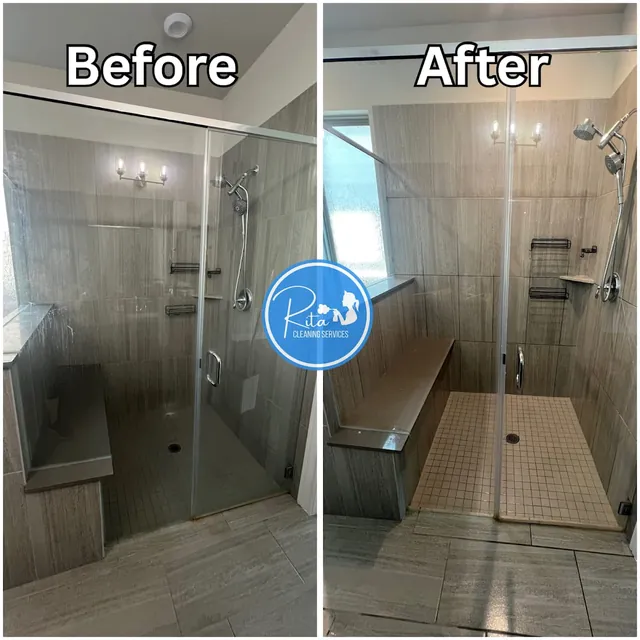
- Glass shower doors and enclosures
- Faucets, handles and the base of fixtures
- Showerheads and tub spouts
- Sink drains and the bottom of sinks
- Tile and grout around the tub and shower
- Dishwasher door and glassware
The spots come back quickly because every shower and every rinse leaves a new thin layer. Left alone for months, those layers build into a crust that takes far more work to remove.
How to clean hard-water spots safely
- Check the surface first. Glass, chrome and ceramic tile handle a descaling cleaner well. Natural stone does not (see below).
- Use a cleaner made to dissolve mineral deposits on glass and fixtures, and give it time to work instead of scrubbing hard.
- Use soft tools. A non-scratch pad or microfiber cloth. Abrasive pads and powders can scratch glass and chrome.
- Rinse well and dry. Leftover cleaner and water left to dry start the next layer of spots.
- Repeat on old buildup. Thick, years-old film may need more than one round and may only lighten rather than disappear completely.
Careful with natural stone
Vinegar and acidic cleaners that work on glass can damage marble, limestone and travertine. The Natural Stone Institute warns that "products containing lemon, vinegar or other acids may dull or etch calcareous stones" (source). If your shower or vanity is natural stone, use a cleaner made for stone.
How to keep spots from coming back
- Squeegee or towel-dry the shower glass after use
- Wipe faucets dry after cleaning
- Clean fixtures little and often instead of letting layers build
- Keep up a regular cleaning schedule for bathrooms and the kitchen sink
What a cleaning visit can do about it
Showers, tubs, sinks, mirrors and glass are part of every regular house cleaning visit, so routine service keeps new spots from building up. If spotting is already a problem, say so in your quote request: the visit can include extra fixture detail, and any natural stone or specialty surfaces can be handled the right way. A deep clean is the better start for a home where buildup has been collecting for a while.
Rita Cleaning Services is based in Round Rock and serves the Round Rock, Leander, Brushy Creek and Austin areas above, plus Cedar Park, Georgetown, Pflugerville and Hutto. Moving out? Hard-water spots are one of the items on the move-out cleaning checklist.
Hard Water FAQ
Quick answers about hard-water spots.
Is Round Rock water hard?
Yes. The City of Round Rock reports average hardness of 221 mg/L, about 12.9 grains per gallon, which is very hard on the U.S. Geological Survey scale.
Why do the spots come back so fast?
Every time water dries on a surface it leaves a thin layer of minerals. With very hard water, those layers build up quickly unless the surface is dried or cleaned often.
Can I use vinegar on hard-water spots?
On glass and chrome, acidic cleaners are commonly used. Not on natural stone: the Natural Stone Institute warns that lemon, vinegar and other acids may dull or etch calcareous stone such as marble.
Can a cleaning remove years of buildup?
Often it improves a lot, but very old film on glass may only lighten rather than disappear completely. Starting with a deep clean and keeping up regular visits gives the best result.
How do I ask for extra attention on fixtures?
Mention it in your quote request, or text (484) 861-7626 or call (737) 359-7877, Monday to Saturday, 9am to 9pm.
Tired of fighting the spots?
Tell Rita where the buildup is and she will follow up with a personalized quote for your home.